
Your cart is currently empty!
Lean Six Sigma Black Belt
₹25,000.00 exc. GST
Download brochure
A role-ready Lean Six Sigma program for professionals entrusted with leading complex problem solving, influencing decisions, and delivering sustained business outcomes at scale

Lean Six Sigma Black Belt
To Enroll, Select a batch above ↑
















Lean Six Sigma Black Belt
₹25,000.00 exc. GST
Program Highlights
Accreditation & Credibility
Benchmark Six Sigma is an Accredited Training Provider of Exemplar Global (formerly RABQSA), a globally recognized certification body and part of the ASQ (American Society for Quality) family.
Exemplar Global accreditation ensures consistent standards, credible assessments, and global acceptance — validating capability without replacing it.

Duration & Format
40 hours, designed for depth, rigor, and transformation-scale problem solving — not accelerated tool exposure.
Live Online
Differentiators
Unique Value Proposition
Why Benchmark Six Sigma
- Built for Transformation Roles, Not Just Tool Mastery — The Black Belt program is designed to prepare professionals for roles where problems are ambiguous, stakes are high, and accountability is non-negotiable, with a focus on judgment, influence, and ownership rather than tool accumulation or mechanical application.
- Legacy of Serious Black Belt Capability Building — Benchmark Six Sigma has been developing Black Belts since the early days of Lean Six Sigma in India, with a long-standing emphasis on rigor, real-world application, and preparing professionals trusted with complex, high-impact initiatives.
- Exemplar Global Accreditation — The Lean Six Sigma Black Belt certification is accredited by Exemplar Global (part of ASQ), ensuring globally consistent standards, credible assessments, and international acceptance, validating demonstrated capability rather than replacing professional responsibility.
- Best-in-Class Facilitation by Master Black Belts — Programs are led by experienced Master Black Belts with deep cross-industry exposure, focusing on how decisions should be made in complex environments, how to select the right analytical depth, and how to balance rigor with practical constraints.
- Advanced Analytics with Disciplined Use of AI — Advanced statistical methods and AI are integrated selectively to support problem framing, hypothesis structuring, analytical planning, and review readiness, strengthening clarity and judgment without bypassing experimentation, validation, or professional reasoning.
- Project-Anchored Learning for Real-World Readiness — Learning is anchored in transformation-level application through Black Belt projects that reinforce end-to-end ownership, stakeholder alignment, and delivery of measurable outcomes beyond classroom analysis.
- Cross-Industry Relevance at Scale — The program remains effective across manufacturing, services, IT, BFSI, healthcare, FMCG, energy, and shared services, where transformation challenges cut across functions and systems.
- Capability That Endures Beyond Certification — Benchmark Six Sigma continuously evolves its Black Belt program to address rising complexity and responsible use of advanced analytics and AI, while preserving the methodological rigor that makes Black Belts credible and trusted over time.
Package Inclusions
This program is delivered as a structured capability bundle, where each component is intentionally designed to prepare professionals for transformation-scale problem solving — not to stack standalone certificates.
- Pre-Training Preparatory Material — Foundational content provided in advance to align participants on advanced DMAIC expectations, analytical thinking, and transformation-level problem contexts, enabling deeper engagement during live sessions.
- Course Material Kit (Black Belt Body of Knowledge) — Comprehensive learning material covering the full Lean Six Sigma Black Belt Body of Knowledge, structured to emphasize analytical judgment, decision logic, experimentation, and correct application in complex, ambiguous environments.
- Data, Templates, and Advanced Analysis Resources — Ready-to-use datasets, analytical templates, experimentation frameworks, and process-mapping formats that support disciplined analysis, hypothesis testing, and evidence-based decision-making at scale.
- 40 Hours of Instructor-Led Live Training — Highly interactive sessions facilitated by experienced Master Black Belts, focusing on advanced analytics, problem framing under ambiguity, stakeholder alignment, and ownership of outcomes, supported by real-world examples across industries.
- 200+ Practice Questions — A rigorous question bank designed to test analytical reasoning, decision quality, and judgment, helping participants identify common pitfalls before applying Black Belt thinking in real transformation initiatives.
- Lean Six Sigma Black Belt Examination — A structured assessment aligned with globally accepted standards, designed to validate advanced understanding, analytical discipline, and correct application of Lean Six Sigma thinking.
- Globally Recognized Certification (Lifetime Validity) — Lean Six Sigma Black Belt certification accredited by Exemplar Global, providing international recognition with lifetime validity, reflecting confidence in the enduring nature of transformation-level capability.
- AI Integration for Advanced Problem Solving — Hands-on exposure to responsible use of AI within Black Belt problem solving, where AI supports problem structuring, hypothesis development, analytical planning, and review preparation, without replacing experimentation, validation, or professional judgment.
- Black Belt Project (Optional Depth Enhancer) — An included Black Belt-level project designed to deepen real-world application through complex, cross-functional problems, reinforcing end-to-end ownership, stakeholder alignment, and measurable impact, while remaining optional for professionals seeking flexibility.
- Bundled Capability Certificates (Enablers) — In addition to the Black Belt certification, participants receive Business Analytics Foundation (BAF), Excellence in Continuous Improvement Leadership (ECIL), and the Statistical Software Tool Proficiency Certificate, intentionally bundled as capability enablers rather than standalone credentials.
Key Benefits
Learning Outcomes
- Transformation-Level Problem Framing — Develop the ability to frame and redefine ambiguous, high-impact problems where objectives are unclear, data is imperfect, and multiple stakeholders hold competing priorities.
- Advanced Analytical Judgment — Strengthen decision-making by selecting the right analytical depth, validating cause–effect relationships, and balancing rigor with practical constraints in high-stakes environments.
- Ownership of Outcomes — Move beyond analysis to take end-to-end responsibility for problem solving, from defining the problem correctly to ensuring improvements translate into sustained business results.
- Cross-Functional Influence — Build the capability to lead complex initiatives without formal authority, align diverse stakeholders, and drive decisions across functions and leadership levels.
- Responsible Use of Advanced Analytics and AI — Apply advanced statistical methods and AI selectively to support clarity, hypothesis structuring, analytical planning, and review readiness, without replacing disciplined reasoning, experimentation, or validation.
- Capability That Scales With Responsibility — Develop a role-ready capability that remains relevant as professionals move into internal change, excellence, and transformation roles where impact, risk, and accountability increase.
Key Focus Areas
Topics Covered
- Transformation-Level Problem Definition and Scoping — Translate loosely defined business challenges into structured, decision-ready problem statements that support alignment and effective action.
- Advanced Analytical Thinking and Experimentation — Apply advanced statistical methods, hypothesis testing, and Design of Experiments (DOE) to establish true cause–effect relationships before implementation.
- Judgment-Driven Use of Data and Statistics — Interpret variation, risk, and uncertainty correctly, using statistics as a decision-support discipline rather than a calculation exercise.
- Change Leadership and Stakeholder Management — Address resistance, manage trade-offs, and influence decisions across functions and leadership levels to enable adoption and sustainment.
- Selective Use of AI in Black Belt Problem Solving — Use AI responsibly to support problem structuring, hypothesis development, analytical planning, and review readiness, strengthening clarity and decision quality without substituting experimentation, validation, or professional judgment.
Click here to view the entire curriculum.
Who It’s For & Entry Requirements
Target Audience (Professional Roles, Experience Level)
This program is designed for professionals preparing for transformation roles, where they are expected to lead complex problem solving, support leadership decisions, and own outcomes at scale.
Relevant for:
- Process, Quality, Operations, and Supply Chain Leaders — Roles responsible for driving performance improvement across core operational value streams.
- Project Leaders, PMO Roles, and Internal Consultants — Professionals leading or supporting cross-functional initiatives that demand structured execution and evidence-based decisions.
- IT, Shared Services, Finance, Risk, and Compliance Professionals — Roles where disciplined problem-solving and analytical judgment are critical to decision quality and risk management.
- Excellence, Transformation, and Continuous Improvement Roles — Positions focused on enterprise-level improvement, change leadership, and capability building.
Prerequisites (Required/Recommended Knowledge)
Preparation Expectations:
- Lean Six Sigma Green Belt — Green Belt certification is strongly recommended as a foundational capability.
- Equivalent Structured Problem-Solving Experience — Prior experience applying disciplined, data-backed problem-solving approaches is acceptable.
- Readiness for Ambiguity and Decision Ownership — Comfort with data interpretation, uncertainty, and responsibility for outcomes is essential.
This program is best suited for professionals seeking long-term relevance and trust, not short-term certification.
Recommended Prior Courses (if applicable)
Lean Six Sigma Green Belt certification (highly recommended but not mandatory).
Methodology & Engagement
Interactive Components (Practice projects, Case studies, Quizzes)
- Practice Projects (Transformation-Level Exposure) — Participants work through Black Belt–level practice scenarios that reflect real transformation challenges, focusing on problem framing under ambiguity, advanced analysis, experimentation, and ownership of outcomes before applying learning to live organizational initiatives.
- Case Studies (Judgment Before Tools) — Each module is supported by transformation-scale case discussions drawn from real consulting and internal change initiatives, emphasizing how decisions are made when data is imperfect, trade-offs are unavoidable, and stakeholder alignment determines success.
- Quizzes (Reasoning- and Judgment-Based) — Quizzes are designed to test analytical judgment, decision quality, and correct application of methods rather than rote recall, with explanations that highlight common errors and strengthen disciplined thinking.
Support Services (Forums, Technical Support, Post-training guidance)
- Forums and Advanced Peer Learning — Participants gain access to an experienced professional learning community where complex, real-world transformation scenarios are discussed, enabling refinement of judgment through exposure to diverse contexts and perspectives.
- Technical Support (Advanced Analysis and Interpretation) — Learning-focused technical support is available to assist with advanced statistical interpretation, experimentation design, and correct use of analytical tools, ensuring participants remain focused on decision quality rather than mechanics.
- Post-Training Guidance (Sustained Transformation Capability) — Continued access to structured references, analytical resources, and learning materials supports application beyond the program, reinforcing the objective of building capability that remains effective as responsibilities and complexity increase.
Certification & Career Advancement
Certification Earned
On successful completion, participants earn the Lean Six Sigma Black Belt Certification, accredited by Exemplar Global (part of the ASQ – American Society for Quality family).
- Globally Recognized Accreditation — The certification adheres to globally consistent standards, includes credible assessment, and is recognized across industries and geographies.
- Lifetime Validity — The certification is valid for a lifetime, reflecting confidence in the enduring nature of transformation-level problem-solving capability.
- Capability-Focused Validation — Certification validates advanced analytical judgment, disciplined problem-solving, and readiness to lead complex, cross-functional initiatives; it does not replace experience, responsibility, or professional accountability.
- Bundled Capability Certificates (Enablers) — As part of the Black Belt capability bundle, participants also receive Business Analytics Foundation (BAF), Excellence in Continuous Improvement Leadership (ECIL), Statistical Software Tool Proficiency Certificate, and Black Belt Project Completion Certificate (for those completing the project), intentionally bundled to reinforce transformation readiness rather than accumulate credentials.
Value to Employers (Efficiency, Cost Reduction, Quality Improvement)
Black Belt–trained professionals support organizations by leading complex improvement initiatives with clarity, rigor, and accountability.
- Efficiency — Drives faster, higher-quality decisions by structuring ambiguity, aligning stakeholders, and avoiding analysis paralysis in cross-functional initiatives.
- Cost Reduction — Reduces cost of poor quality and systemic waste by rigorously validating root causes, preventing recurrence, and avoiding trial-and-error solutions at scale.
- Quality Improvement — Improves process stability and performance through disciplined experimentation, correct interpretation of variation, and sustainment mechanisms suited for complex systems.
Career Goals (Roles you can aim for post-certification)
Lean Six Sigma Black Belt signals readiness for roles where professionals are entrusted with leading transformation-scale problem solving and owning outcomes.
- Operational Excellence and Transformation Leaders — Roles accountable for driving enterprise-wide improvement initiatives and delivering measurable performance outcomes.
- Senior Process Improvement or Quality Managers — Positions responsible for leading complex improvement efforts, ensuring analytical rigor, and sustaining results at scale.
- Internal Consultants and PMO / Change Leaders — Professionals supporting leadership decisions, managing cross-functional initiatives, and enabling structured execution across programs.
- Shared Services, IT, and Enterprise Improvement Leads — Roles focused on improving efficiency, quality, and service performance across technology-enabled and support functions.
- Business Transformation and Performance Improvement Managers — Positions tasked with leading high-impact transformation initiatives and embedding disciplined problem-solving across the organization.
- Pathway to Advanced Roles — Black Belt serves as a critical foundation for advanced pathways such as Business Excellence (MBB) and other enterprise-level transformation roles, where strategic influence and system-wide impact are expected.
Course Pathways & Bundles
Bundled Programs (Packages or pathways that include this course)
Lean Six Sigma Black Belt is available through the following structured bundles.
- Advanced Excellence Pathway — Lean Six Sigma Black Belt with LPLG (Lean Practitioner and Lean Guide), strengthening advanced Lean capability alongside Black Belt analytical depth.
- Comprehensive Operational Excellence Pathway — Lean Six Sigma Green Belt, Lean Six Sigma Black Belt, LPLG, and the Black Belt Certification Project, providing an end-to-end transformation capability stack.
- Lean Six Sigma Black Belt Bundle – Lean Six Sigma Black Belt delivered as a comprehensive capability bundle that includes Business Analytics Foundation (BAF), Excellence in Continuous Improvement Leadership (ECIL), Statistical Software Tool Proficiency Certificate, and one Black Belt project (Service or Manufacturing). Participants may opt to complete an additional Black Belt project to deepen application exposure and transformation readiness.Lean Six Sigma Black Belt delivered as a standalone program, with the Black Belt Project available as an optional depth enhancer.
Suggested Sequence
Lean Six Sigma Black Belt sits within a clear, progressive capability pathway, where responsibility, complexity, and influence increase step by step.
- Step 1: Lean Six Sigma Green Belt — Establishes structured problem-solving discipline, data-based thinking, and correct application of DMAIC within defined process scopes.
- Step 2: Lean Six Sigma Black Belt — Builds transformation-level capability to handle ambiguous, cross-functional, high-impact problems, requiring advanced analytics, judgment, stakeholder influence, and ownership of outcomes.
- Step 3: Black Belt Project (Optional Depth Enhancer) — Provides real-world validation through application on complex organizational problems, strengthening credibility, confidence, and transformation readiness.
- Step 4: Advanced and Strategic Capability Programs — Programs such as Business Excellence (MBB), DFSS, Business Analytics, AHP, Hoshin Kanri, or Business Modelling, selected based on evolving role expectations and organizational context.
This sequence ensures professionals progress from structured problem solving to transformation leadership, applying advanced methods on a strong, disciplined foundation.
Return on Investment & Practicalities
Return on Investment (Salary increase potential, Recognition)
Lean Six Sigma Black Belt builds a transformation-level problem-solving capability that organizations value in roles carrying higher responsibility and impact.
- Potential for Salary Increase — Professionals who demonstrate the ability to lead complex, cross-functional initiatives and deliver sustained business outcomes are better positioned for progression into higher-impact and higher-compensation roles.
- Qualification for Higher-Level Positions — Black Belt signals readiness for roles requiring advanced analytical judgment, stakeholder influence, and end-to-end ownership of outcomes across functions and systems.
- Recognition as a Transformation and Process Improvement Leader — Certification establishes credibility as a trusted professional capable of handling ambiguity, trade-offs, and high-stakes improvement initiatives.
Capacity Limits
Around 20–25 participants per session to enable meaningful interaction, rigorous discussion, and effective guidance during advanced analytical and application-focused activities.
PDUs
56
Learning Pathways
Find out your ideal curriculum based on your current position and growth path.
Worldwide Certificate
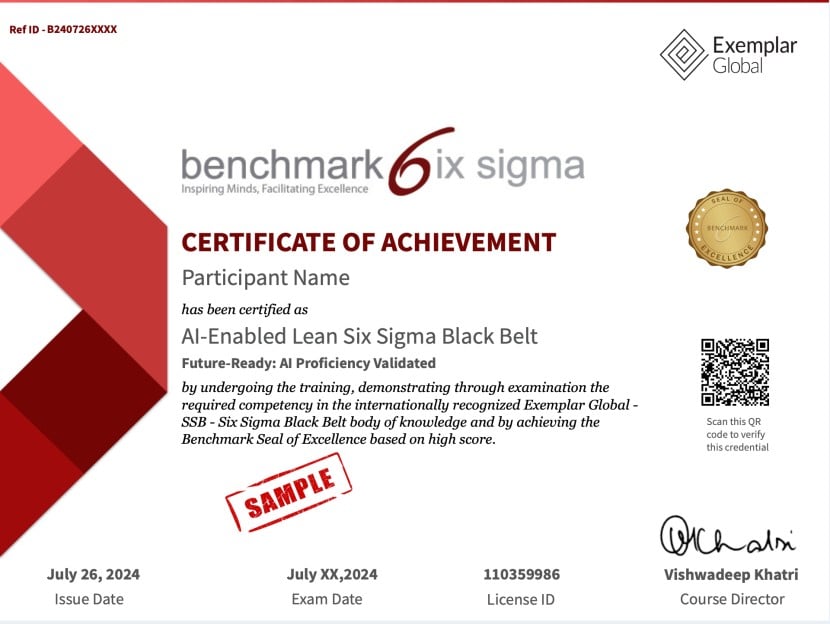
Obtain your Exemplar Global certificate upon completion of your course and join 5,000+ others that have come before you.
-
Amit Kumar Bilandi
15/10/2026
Excellent Learning in Short Time; Outstanding Teaching
"Benchmark provided excellent learning in a short duration, and I commend Venugopal sir for his outstanding teaching approach." -
Balaram Mondal
15/10/2026
Senior manager 2
Meticulously Structured Course with Simplified Guidance
"The course is meticulously structured for easy comprehension, with the instructor guiding participants through concepts in a simplified manner." -
Tanmoy Mondal
15/10/2026
Deep understanding of pharma tools
"This course offers a deep understanding and practical application of various tools in pharmaceutical development and data analysis." -
Jagjit Singh Banwait
15/10/2026
Enriching LSSBB experience; confident to serve clients
"My experience with Benchmark Six Sigma while learning LSSBB techniques, methods, and methodology was enriching. I'm confident it will enable me to provide error-free services to my clients." -
Sudhansu Sekhar Nanda
13/10/2026
A Valuable Journey in Lean Six Sigma
The Black Belt course was highly informative, well-structured, and practical. It strengthened my understanding of Lean Six Sigma concepts and enhanced my ability to apply them effectively to real-world problem-solving and process improvement. -
Aarti Sukhrani
08/10/2026
Practical and Well-Structured Learning
The course material was highly practical, with modules arranged in a logical sequence. Kappa focuses on problem agreement and data reliability, Rho evaluates process stability and capability, and Delta identifies significant causes. Realistic examples from banking, BPO, healthcare, shipping, and manufacturing made the concepts relevant and easier to apply across industries. -
Grishan Gopalan
07/10/2026
Practical Statistical Problem Solving
A strong, practical, and well-structured course that developed genuine statistical competency rather than just theoretical knowledge. The hands-on integration of Minitab was particularly valuable, as concepts were immediately demonstrated through practical applications, making the tools easier to understand and use confidently. The trainer’s decision-focused teaching approach—helping us understand which tool, test, or chart to use based on the data and situation—made the learning highly relevant to real-world problem solving. Realistic worked examples helped translate complex statistical concepts into practical applications, while interactive quiz-style recaps at the beginning of each session reinforced learning and retention. Most importantly, the course gave me greater experience and exposure to practical problem-solving, along with a significant mindset shift toward structured problem solving, data-driven decision-making, and continuous improvement. Overall, it was a highly valuable learning experience that I can apply directly in my professional work. -
KOPPU MANOJ KUMAR
06/10/2026
QUALITY ASSURANCE ENGINEER
Enhanced Lean Six Sigma Expertise
The course significantly enhanced my understanding of Lean Six Sigma methodologies and statistical problem-solving techniques. I would highly recommend it to quality professionals looking to strengthen their Lean Six Sigma Black Belt knowledge and develop practical skills. -
Sathiyaraj E
05/10/2026
Clear and Effective Learning
The Benchmark learning materials were excellent and made it easy to understand the concepts and value of the service. The facilitator explained the topics clearly and used relevant examples that made the learning more practical and easier to follow. -
Anuradha Verma
05/10/2026
Broadly Applicable Learning
This course is good for the people for not only who are in corporate but also for the people who are doing and kind of research, business or working in any field.
Chat with our AI Assistant
Is this course for you? What are the main differentiators? What does it include? Get the answers you need, instantly:
Frequently Asked Questions
What is Lean Six Sigma?
Lean six sigma is business management approach which focuses on reducing defects, eliminating wastes and generating big financial benefits. It aims in improving efficiency and customer satisfaction in any process. It focuses on – Data Driven Decision Making, Problem Solving and Process Improvement. Lean Six Sigma is the integration of Lean and Six Sigma. In our program, Lean basics are covered along with detailed coverage of advanced Six Sigma tools and techniques.
What are the reasons for people to undergo Lean Six Sigma Training?
- Help your organization get rid of defects, errors and waste.
- Generate savings worth millions of dollars.
- Develop competence that is applicable across domains.
- Get the most desired competencies for management positions.
- Analyze processes and improve or re-design them.
- Considered a prospect for leadership positions as someone who carries out cross functional
- projects of high business value is preferred at the top.
- Become a respected problem solver and decision maker.
- Learn world-class problem solving sequences.
- Encourage progressive and zero defect mindset.
- Enhance your profile.
How is your course different from ASQ?
- Benchmark Six Sigma programs are accredited by Exemplar Global which is also a part of ASQ family. However, ASQ has its own exams as well. The curriculum is comparable. There are some differences in training and exam structure as follows –
- Benchmark Six Sigma training has a single fee for training and exam. ASQ charges for training and exam separately.
- Benchmark Six Sigma exams allow use of best-in-class calculators on the website so that participants do not need to remember complex formulae.
- ASQ forum has an additional membership fee but Benchmark forum comes as free for all participants
When do we get the results?
The examination result and the Certificate are provided to all the participants individually within 2 days after the examination.
Can I write the examination without attending training?
Yes, you can. You will need access to materials. This access requires enrolment and you need to pay full course fee for enrolment.
Will I get additional certificate if I complete a project in my company after completing the Lean Six Sigma training?
Yes, if you complete a live project within your organization within 3 years of completing the training. You will have to submit the project details to Benchmark for review and appear for a project interview.
How is an an AI- enabled course certificate different from the normal courses?
An AI-enabled Lean Six Sigma course certificate signifies that the holder is not only proficient in Lean Six Sigma methodologies but also skilled in applying artificial intelligence to enhance these processes. This combination prepares professionals to tackle complex challenges in today’s data-driven and technology-focused business environments, offering them and their organizations a significant advantage over those with traditional certifications. Our AI-enabled programs meets and exceeds traditional courses by preparing you for future-ready competence. Remember, a lot is happening in the AI world. In our AI-enabled program, we provide you with the latest insights and guide you on how to keep yourself up to date.
How many Practice Projects do you provide with the Lean Six Sigma Black Belt course?
We provide 1 complimentary certification project in Black Belt. For the certification project in BB, the participant can choose from a manufacturing related project or a service related project.
Is a project mandatory for Black Belt training?
No project is not mandatory for BB training with Benchmark Six Sigma.
I am only Black Belt trained and has not completed any projects. Do you provide any projects?
Yes. We provide certification projects to Black Belts. You can choose from a service sector or manufacturing sector project. It is a self paced certification project course. Upon completion a project certificate will be issued. Please keep in mind that this is not a live project, it is a certification project I which the data is masked and project is not being done for any organization.
I am only interested in in-person training. Do you offer only online sessions?
There are risks of distraction in online training, but for a focused person, there are several advantages as well.
- Most people find it challenging to concentrate for 8 hours a day, so online training is conducted in smaller sessions.
- Asking questions on chat is easy without disrupting the training.
- Trainer and screen visibility is always great in online training.
- Participants can share screens and solve their doubts.
- If you miss a session, you can review a recording.
- You save travel time. You are also safeguarded from other risks related to traffic and health.
- Batches are frequent, and you will easily find one that suits your schedule.
- Offline training will cost more than double online training, even if we do it later.
- Times have changed fast, and we have perfected the online delivery. We have hundreds of satisfied participants who feel that our online sessions were equally or more engaging than offline sessions. Many of them were amazed to experience such an engaging and interactive online session.
How does Benchmark Six Sigma differentiate itself from other training providers?
How Benchmark Six Sigma stands apart
Globally aligned certification standards
Application-driven training methodology
Decades of practitioner-led expertise
Proven outcomes through testimonials
Large, engaged professional network
Are all professional training providers equally qualified?
Not necessarily.
Authorization to train is important, but real capability development depends on:
- Practitioner depth
- Industry relevance
- Learning design quality
- Post-training support
- Real-world application focus
Choose a provider based on outcomes, not just credentials.
Once enrolled in a batch, can I switch to a different batch if I face an unforeseen situation?
Yes, a batch change may be considered in the event of a genuine and unforeseen situation.
That said, batches are carefully planned to ensure learning continuity, group interaction, and effective facilitation. Therefore, batch transfers are not routine and are supported only in exceptional circumstances. If such a situation arises, participants are encouraged to inform the team at the earliest so that the request can be reviewed and guidance provided.
What is the value of the Exemplar Global certificate compared to other institutes?
Exemplar Global was formerly known as RABQSA. RABQSA was established in 1991 and has over three decades of history in setting and governing professional certification standards.
This long-standing legacy, combined with its evolution into Exemplar Global, reflects the organisation’s sustained focus on credibility, rigor, and global recognition in professional certification.
How can I learn more about Exemplar Global? How do I confirm that it is part of the ASQ family?
Please refer to http://www.exemplarglobal.org/who-we-are/
Where will the course material be available?
All materials, quizzes, case studies, and practice links are available in our online academy after enrollment. Access to the online academy is available for one year.
Is a laptop required during the training?
A laptop is highly recommended for all training programs, as the sessions are interactive and include hands-on exercises, live demonstrations, and guided practice.
Participants are expected to actively work along during the sessions, which is best supported on a laptop or desktop computer. If you plan to use a company-issued device, please ensure you have the necessary access rights to install or use required applications and tools during the program.
While it may be possible to attend certain parts of the session without a laptop, the overall learning experience and practical value are significantly enhanced when you have a laptop available throughout the training.
Where can I get the payment link? How can I enrol?
You can enrol directly from the course page. Once you are on the product page, select the available batch (where batches are announced) and add the course to your cart.
You can then proceed to make the payment online. Upon successful payment, you will receive instant confirmation along with an enrolment email that includes all the relevant details for your course.
If you need any assistance before completing your enrolment, you may reach out to the team for guidance.
Can I speak to someone before registration?
Yes, please suggest your preferred time and mode of contact using our contact form and we shall get in touch with you. Alternatively, you can contact us by WhatsApp or phone call at +91 9811370943